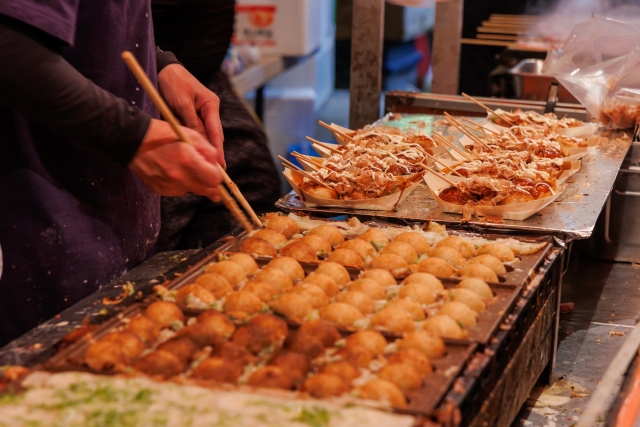
Osaka has a reputation as Japan’s food city, and it earns it.
Much of that reputation is built on kuidaore — a local expression for spending yourself into ruin on food — and a lot of that eating happens outdoors, at stalls, counters, and holes-in-the-wall that line the city’s busiest streets.
At the heart of this culture is the yatai.
What Is a Yatai?
Yatai (屋台) are food stalls — portable or semi-permanent stands where vendors cook and sell food directly to people on the street.
The word literally means “shop stand,” and the tradition dates back to the Edo period (1603–1868), when yatai were a common sight in towns and cities across Japan, serving everything from soba to sushi to grilled skewers.
Yatai in Osaka: Street Food with Its Own Character
Japan’s most famous yatai scene today is in Fukuoka, where rows of covered stalls line the riverbanks each evening.
Osaka’s version is different in form but equally deep in culture.
Rather than concentrated riverside rows, the city’s street food tradition lives in its covered arcades, canal-side promenades, festival grounds, and the standing counters of small specialist shops that blur the line between stall and restaurant.
The food — takoyaki, okonomiyaki, kushikatsu — grew directly out of yatai culture and remains inseparable from it.
The Foods to Know
These are the dishes most closely tied to Osaka’s street food and yatai tradition.
You’ll find them at proper stalls, takeout windows, and sit-down spots alike.
- Takoyaki: The city’s signature street food. Wheat batter balls with diced octopus, pickled ginger, and green onion inside, finished with bonito flakes and savory sauce. They originated in Osaka in the 1930s and remain the clearest example of the city’s yatai culture in edible form.
- Yakitori: Skewered grilled chicken, seasoned with either salt or a soy-based glaze and cooked over charcoal. A staple of yatai and izakaya alike — simple, quick, and best eaten standing or perched at a counter.
- Okonomiyaki: A savory pancake of batter and cabbage with your choice of protein, cooked on a griddle. The Osaka version mixes the ingredients together before cooking, which sets it apart from the layered Hiroshima style.
- Ramen: Not specific to Osaka, but a permanent fixture at food stalls and ramen shops across the city. Osaka’s versions tend toward lighter broths, though you’ll find every regional style represented.
Where to Eat
Osaka’s yatai-adjacent food spots range from outdoor stalls at festivals to small specialist shops that cook everything in front of you.
Here are three that are worth knowing about.
Torikizoku: Yakitori at Izakaya Prices
Torikizoku is not a yatai — it’s a yakitori izakaya chain with roots in Osaka, now found across Japan.
But it’s relevant here for two reasons: it was born out of the same culture that made yakitori a street food staple, and it’s one of the most accessible ways to eat well and cheaply in the city.
The atmosphere is loud and casual, and the chicken is consistently good.
Look for the bright yellow sign near major train stations.


Creo-ru: Takoyaki and Okonomiyaki in Dotonbori
Creo-ru occupies an interesting middle ground — there’s a takeout stall out front for people who want to eat and walk, and a sit-down restaurant below street level for those who want to linger.
It’s a good option if you want to try both takoyaki and okonomiyaki in the same visit without wandering between multiple spots.
Located in Dotonbori, it tends to have a line in the evenings.

Ramen Yashichi: A Bowl Worth Stopping For
Ramen Yashichi is a small ramen shop rather than a traditional yatai, but the counter-seating, open kitchen, and focused menu give it something of the same feel.
It draws a loyal local crowd, which is generally a more useful signal than any guidebook ranking.
A Few Tips Before You Go
Eating at stalls and counter spots in Osaka comes with its own rhythm.
A few things that help:
- Eat where you buy. At most yatai and street stalls, the expectation is that you eat on the spot rather than walking off with your food. There’s usually a small counter or standing area nearby for exactly this purpose.
- Cash is still useful. Many smaller stalls are cash-only. Having some yen on hand avoids the awkward moment at the counter.
- Weekday evenings are the sweet spot. Busy enough to have atmosphere, quiet enough that you won’t be waiting 20 minutes for takoyaki.
- Learn one phrase. Even a basic “kore hitotsu kudasai” (one of these, please) goes a long way at a stall where the vendor is juggling multiple orders at once.
Shinsekai: The Best Neighborhood for Street Food at Night
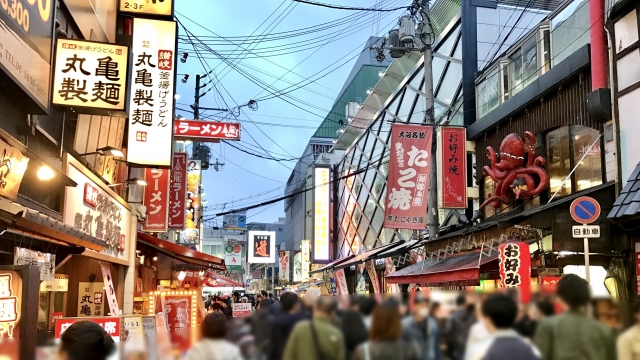
If you want to experience Osaka’s street food culture in a concentrated form, Shinsekai is the place to go.
In the evenings, its narrow streets fill up with kushikatsu shops, takoyaki stands, and small izakayas, many of them operating with open fronts that blur the line between indoor and outdoor.
Kushikatsu — battered and deep-fried skewers of meat, seafood, and vegetables — is Shinsekai’s signature dish and probably the best thing to order here.
The local rule is no double-dipping in the shared sauce, and it’s enforced in most spots.
Tsutenkaku Tower, the neighborhood’s retro landmark, makes for an easy orientation point.
Getting There and Getting Around
Shinsekai is a short walk from Shin-Imamiya Station (JR Loop Line and Nankai Line) or Dobutsuen-mae Station (Osaka Metro Midosuji and Sakaisuji Lines).
For Dotonbori and the Namba street food area, Namba Station is the main hub, served by Osaka Metro, Nankai, Kintetsu, and Hanshin lines.
Most of Osaka’s best street food is within a short walk of a major station, which makes it easy to combine with a broader day of sightseeing.
comment